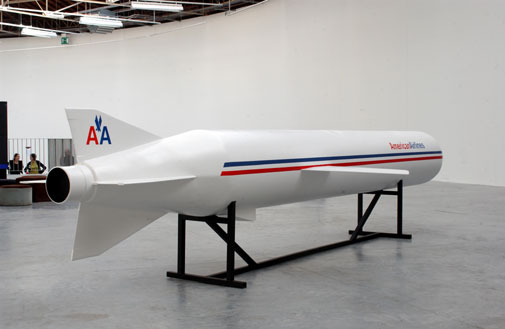
Alain Declercq
FEED-BACK /AMERICAN AIRLINES, 2003, resin and metal, American Airlines logo
mix Missile Tomahawk and Boeing 757, 600 X 250 X 130 cm
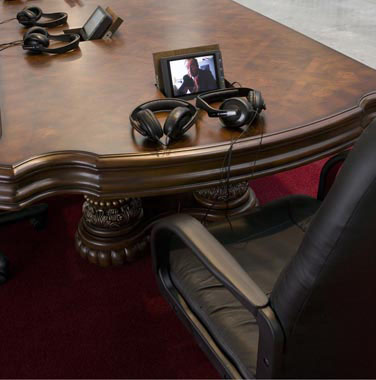
WAR GAMES, 2006, acajou table, seats, 4 LCD screens, video "Mike", "état de siège", "PHB ITV", Feed-back/ Pentagon", 330 X 150 X 70 cm
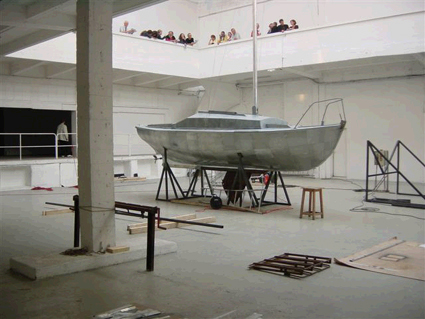
JOLLY ROGER, 2002, armoured yatch
600 X 300 X 800 cm
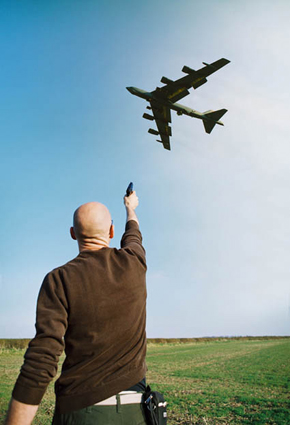
B 52, 2003, offset print, edition of 8
US base Fairford (GB), bomber flying to Bagdad, 180 X 120 cm
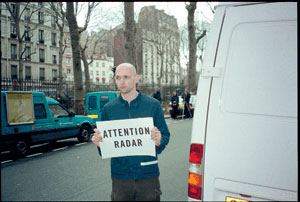
ATTENTION RADAR, MANIFESTE 12 , 2001, color photography
88776/C/ FG.
Presiding over case 88776/C/ FG.
Case within the jurisdiction of Bourges - 18000 –
Deposition of M. Declercq before Inspectors Poret et Boisdet
Clerk: L. Quillerié
Stopped and questioned by police, M. Declercq, born 6 November 1969 in Moulins (Department of Allier - France), profession "plastician," in the subject’s own terms signifying “artist,” of French nationality residing in Paris, 4, rue des Filles du Calvaire, 3rd arrondissement, was conducted to Police Headquarters. During his deposition, M. Declercq has acknowledged that this is not his “first time” (offense).
During the national “VigiPirate” antiterrorist plan to insure security, in 1998, M. Declercq fraudulently placed himself among the members of the police force. In his words, this entry was only an “artistic proximity.” Nevertheless, he immediately declared that his point was to keep watch over those who were keeping watch.
However, in light of the present facts and earlier instances of being stopped and questioned by the police, M. Declercq admits to having in essence filmed the arms carried by officers on duty, an extremely serious act since not only could his presence have hindered the ability of the police force in place to respond to possible threats, but his film represented a terrorist attempt of infiltration linked to the criminal act of reconnoitering law enforcement.
In 1999, M. Declercq repeated his offense by photographing undercover police officers during demonstrations in Paris. He declares that he simply wanted to study (“discover,” as he puts it) the secret codes of undercover officers. Here again the act can be considered as interference with the right and proper exercise of police business.
M. Declercq acknowledges having practiced “forgery” since 1997. His method employs the best means currently available in computer technology since in this instance he uses reproduction software and scanners. These forgeries, moreover, have been displayed in Luxembourg, in a private gallery that the accused does not wish to name. The display of these forgeries constitutes a clear criminal offense pursuant to the statutes covering the private life of citizens.
In 1998, the accused, M. Declercq, turned to computer piracy. He confesses that his virus, which is passively spread, consisted in fraudulently introducing into the computers of visitors to his site an image of one Bill Gates, a billionaire who is well known internationally, whenever a visitor “clicked” onto the artist’s project posted on a Web site.
As early as 1996, M. Declercq committed the criminal acts of voyeurism and exhibitionism for the benefit of what he calls “works of art.” The CD-Rom entitled “Vis-à-Vis” distributed in France shows scenes from the private life of French persons filmed without their knowledge. M. Declercq insists on pointing out that “people aren’t recognizable” since the images distributed measured 30mm by 50mm, or approximately 1 3/8 inches by 1 7/8 inches in Imperial linear measure. As for the acts of exhibitionism, the accused acknowledges having distributed a portrait of a male individual membro virili erecto (in the manly state) suspended and revolving with the assistance of a harness.
In July 2000, during the official parade of French armed forces for the 14 July national holiday, the accused acknowledges having filmed the armed forces in the course of their preparations for the parade, again unbeknownst to them. M. Declercq brazenly declares that he was “very pleased to film the arrival of the French armed forces via Porte de la Muette” in the 16th arrondissement of Paris.
In 1999, M. Declercq confesses to having trumped up an abduction by automobile in order to, in his words, “constitute an artistic act.”
The abduction was filmed and shown in sundry artistic venues
In May 2001, the accused declares that he was the “orchestrator” of a “fictional” escape from a site located in Bourges that goes by the name “Transpalette.”
However, this fiction required the use of a helicopter, the preferred means of transportation in cases of serious outlawry.
That same year, in the city of Cairo, Egypt, the accused caused a series of accidents with the country’s police force and damaged a police vehicle by setting in motion at a very rapid pace two Mercedes of the French embassy, symbol of France’s presence abroad.
In 2002, M. Declercq induced a member of the police force to commit an unlawful act, having the said member discharge 650 high-caliber bullets (9mm, 357 magnum) in a public place of dubious moral character in order to write out “Death instinct,” the title of the book published by the lawbreaker Jacques Mesrine.
In 2001, the accused photographed houses and personal automobiles of notables in the city of Montreal, Quebec Province, Canada, unbeknownst to them, and subsequently put up these photographs throughout the city streets in the form of posters inciting civil rebellion among the population.
In 2002, the murder of two personalities from the French art world in a Buffalo Grill located in the purlieus of Quimper, Finistère, by an individual of Middle Eastern appearance is not unknown to the accused. He denies any involvement and has refused to reveal the identity of the unknown assailant, who seems at present to have fled abroad. This case, currently under investigation, suggests that M. Declercq was indeed present at the time of the crime; witnesses will be summoned to make a possible identification.
In 2002, M. Declercq undertook to reproduce a police car (make Citroën “Evasion”) and encouraged the public to drive it around the streets of the city of Brétigny-sur-Orge, France, to in effect replace the lawful police force and attempt to disrupt both the right and proper exercise of police authority and the security of the citizenry.
The accused concludes his deposition by declaring that his past actions should in no wise influence the judge responsible for the case to favor an eventual indictment.